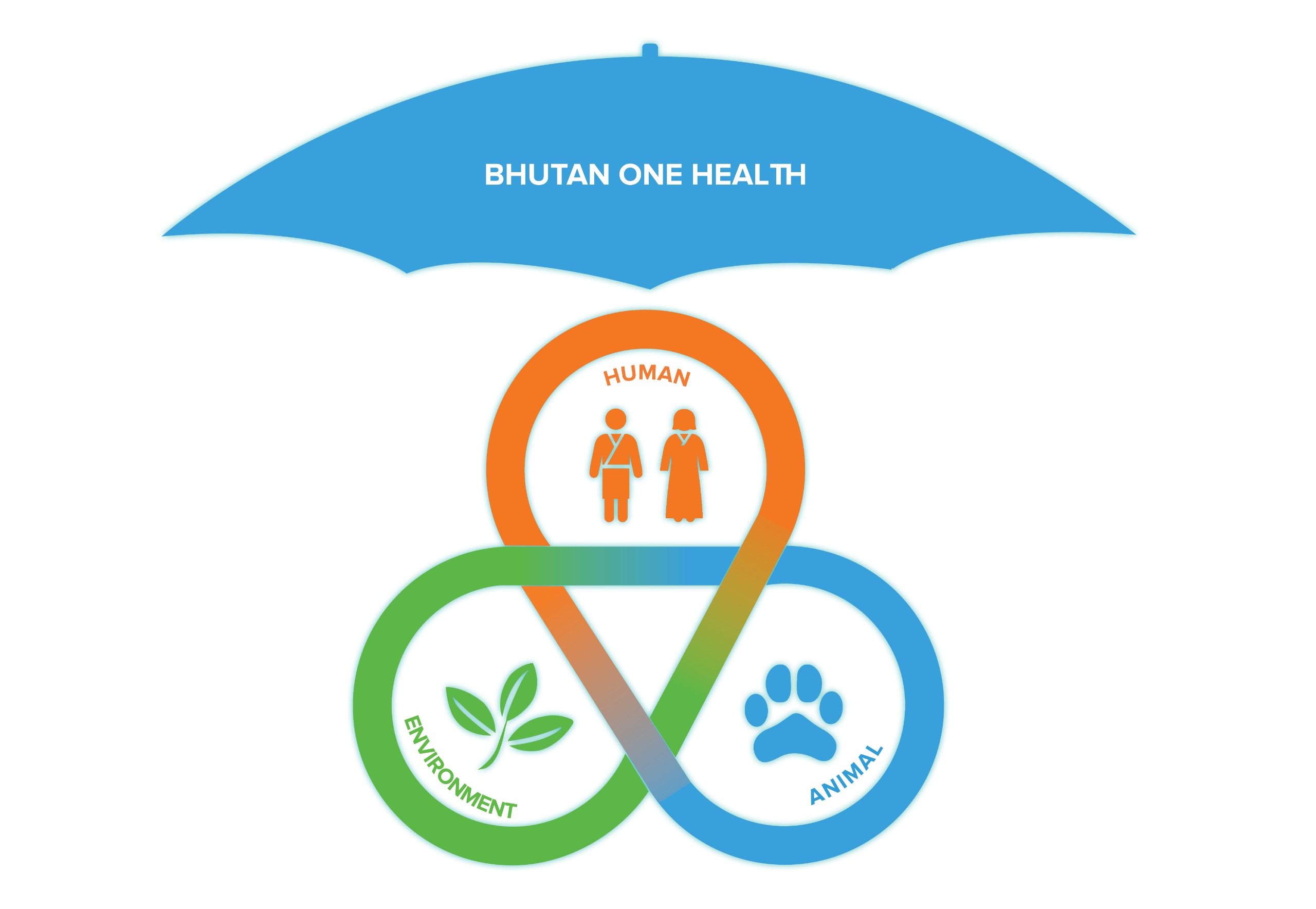
About Bhutan One Health
Bhutan has adopted the One Health approach, grounded in the principle that "a healthy nation ensures a sustainable future." This integrated framework acknowledges the interconnectedness of human, animal, plant, and environmental health.
Our vision
A resilient and harmonious Bhutan where human, animal, and environmental health are safeguarded through an integrated One Health system driven by coordinated governance, innovation, and inclusive community engagement.
The Quadripartite Framework
The Quadripartite partnership — comprising the Food and Agriculture Organization (FAO), the World Health Organization (WHO), the World Organisation for Animal Health (WOAH), and the United Nations Environment Programme (UNEP) — represents a unified global effort to address complex challenges at the human–animal–environment interface. The One Health Joint Plan of Action (OH JPA) serves as a structured, legally endorsed framework to address health challenges across humans, animals, plants, and ecosystems.
Human Health
Surveillance, vaccination programmes, outbreak response (DoPH, RCDC).
Animal Health
Veterinary surveillance, zoonotic pathogen monitoring (NCAH, MoAL).
Plant Health
Crop and forest surveillance, phytosanitary monitoring, plant pest and disease control (NPPC, DoA).
Environmental Health
Water quality, climate factors, wildlife interface (DECC).
Governance
Bhutan's One Health governance framework adopts an integrated, multisectoral approach to managing health risks at the human–animal–environment interface.
- • Steering Committee (IMCOH) — provides high-level strategic leadership and coordination for the One Health agenda. Chaired by the Secretary of the Ministry of Health and the Ministry of Agriculture and Livestock on an alternating basis.
- • Technical Working Group — DoL, DoPH, NCAH, RCDC, BFDA, DoFPS, DECC
- • Country Liaison — WHO & FAO Country Offices, Bhutan